Tuesday, 19 February 2019

Regulation Homework


Final Scene Analysis

Camera

-High angle looking down on social worker  from Benny – Patriarchy
- Extreme close up on phone after it falls connoting extreme panic. 
Most camera shots of the young people were eye level showing equality amongst us and directly with the audience
- Gun shot was long shot of Connie which cut to close up of Eleven. This shot demonstrates panic
- Level three shot of boys in woods with Mike in the front showing he is the leader
- Two mid shot of Jonathon and Joyce close on the sofa signifies closeness in relatio
nship

Mise En Scene

Byers’ house – dim lighting, brown clothes, 80s interior connoting poverty 
- Yellow phone contrasts and stands out showing it is important and for communication to Will.
- Benny’s diner is where Eleven seeks shelter - is a stereotypical suburban diner.
- Woods is dark and raining with thunder showing pathetic fallacy that something bad may happen.
- Nancy’s bedroom is stereotypical of a studious teenage girl in the 80s.
- Choppers, torches, shine Eleven’s, theme of light within the final scenes. 

Sound

Off screen sound of pot wash in Benny’s diner to on screen of Benny washing 
- Off screen diegetic knocking showing disruption in the narrative and raises alarm 
- Diegetic dialogue ‘you don’t sound the same as you did on the phone’ shows suspicion 
- Non diegetic contrapuntal song commences as soon as Benny is shot – White Rabbit Jefferson – volume and pace increase as Eleven runs away emphasising the panic and the disruption.
- Non diegetic sci fi instrumental emphasises tension when the boys find Eleven 
- Joyce on the phone with on screen diegetic sound of mysterious creature/ potentially Will.
- Nancy’s room – Africa Toto is contrapuntal – romantic mood – 80s theme

Editing

- Many jump cuts in Nancy's room showing the close proximity between her and Steve and intimacy.
- Pace of cuts increase when Connie shoots Benny connoting danger and panic. 
- Sound effect of electric bang when the phone cuts out showing that Will may be in danger. Sci fi. 
- Shot reverse shot during conversations between two people showing follow of dialogue. 
Order of the narrative – multi stranded narrative underlines the LFTVD drama conventions. 
- Most scenes happen simultaneously except Eleven’s escape and discovery which links the characters at the end of the episode leaving on a cliff hanger for the next episode. 

Thursday, 31 January 2019

Stranger Things Presentations

OwnerShip:
https://docs.google.com/presentation/d/1WcOZORCu8fFKySiAlzXFDJ8EZIe26SJyc9ijsDJm8p4/edit?usp=sharing

Production:
 https://docs.google.com/presentation/d/1hPOdOLhCoMXUMpyvVQj5BqzCWgECtAtC1casZ3Nv6iQ/edit?usp=sharing

Distributuion:
 https://docs.google.com/presentation/d/1-1c6Ikuopbl7ItwvhWcHWAQfXHM3uzCAurdBLl_Wb08/edit?usp=sharing

Circulation:
 https://docs.google.com/presentation/d/1RDBwl4DcrSHPSEI3e_-kY4B-Kym7_Sv9t76ceN5_rHo/edit?usp=sharing

Social Group Essay


How are different social groups represented in the sequence you have analysed? What role does the use of media language, signs and signifiers have in constructing and presenting these representations as real?

The sequence I have analysed is the first episode of Stranger Things. This allows the audience to be introduced to the different social groups that are being represented throughout the episode.
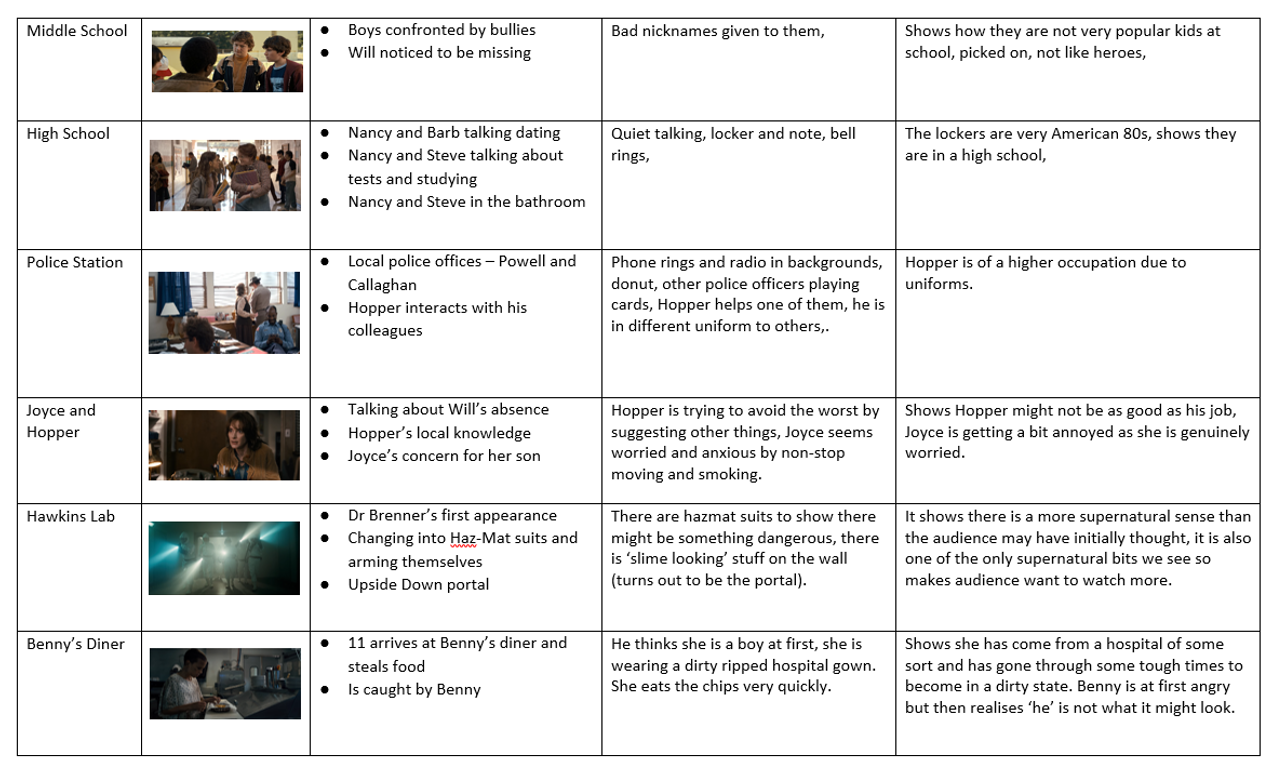
A major social group being represented in Stranger Things is teenagers. This group is then split into two; the older teenagers and the younger ones. The older teenagers are Nancy, Jonathan and Steve. Nancy and Steve are stereotypical representations of teenagers in the 80s because Nancy is very dedicated to school but also has a keen interest in talking about boys with her best friends. This is because Nany is first shown on the phone (which is an 80s one) talking to her best friend Barb about boys.  Steve is the school jock, popular and comes across as a bit of a jerk. Jonathan however, is not the stereotypical teenager as he helps out his family. For example, he sates how he took an extra shift for money but he is giving this money to the family and not spending it on himself. He is also first show as cooking breakfast, before waking up his brother. This suggests he is becoming the father figure.
Secondly, the other group of teenagers is the younger lot of boys. They give a representation of geeky, bullied elementary school children. This can be seen from when they stay after class to look at the new radio the school has gotten in. Also there is a scene when two other boys start picking on them for their appearances.  Another scene that adds to this representation is when the boys are in Mike’s basement playing the board game Dungeons and Dragons. Later, Mike states they have been playing for almost 10 hours, which shows their dedication to the game.
Another group being represented is families and their relationships. The two families we see in this first sequence is Mike’s family and Will’s. Mike’s family is a proper American, middle classed family which don’t seem to have a close bond. The mother is the one to make the rules and the father just agrees, like when Mike wants his friends to stay longer but his mother won’t allow. He then proceeds to ask his dad and he just tells him to listen to his mother. She is stereotypical because she is seen making the dinner and looking after the baby too, which is a stereotypical mother in the 80s. In contrast, Will’s family is close and not the stereotypical family of the 1980s. This is because Joyce Byer’s seems to work quite a lot to provide for her family, she is constantly seen wear her uniform in multiple scenes. Also, the father figure is now put onto the teenager Jonathan as he is seen making breakfast and suppose to get Will up for school.